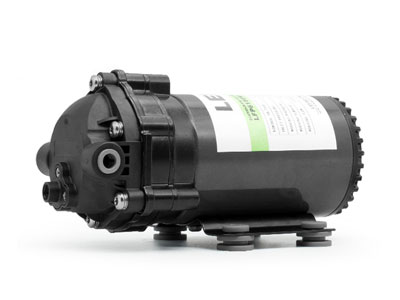
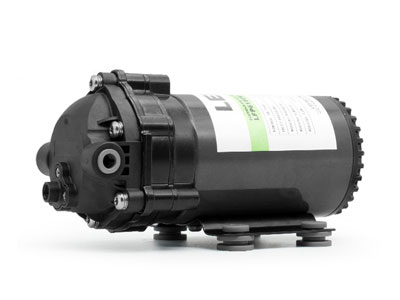
LEFOO diaphragm pump for water purifier 115V is an RO water pump. The diaphragm pump for water purifier 115V is supplied with alternating current (AC), and the AC voltage is capable of being set as a 115v water pressure pump, which is rectified into a direct current (DC) voltage through the built-in control panel of the pump which feeds power to the motor.
Principle of AC 115V Powered RO Diaphragm Water Pump
After being energized, the motor converts the electric energy through the shaft rotation to output a certain speed and torque into mechanical energy. The head of the diaphragm water pump is equipped with an eccentric device. When the shaft rotates, the diaphragm inside the pump is reciprocated through the eccentric mechanical device, so that the fluid in the pump cavity is stretched and compressed to form pressurization, which is generated at the water inlet and outlet The pressure difference draws the liquid into the pump cavity under the action of pressure and then discharges it from the water outlet.
Reverse Osmosis Pre-Permeate Treatment
Pre-Permeate is critical for the lasting of an RO water system to prevent fouling, and too frequent cleanings, and premature failure of the span RO membrane. Here is common RO system issues about Pre-Permeate:
Fouling happens when contaminants accumulate and clogging on the membrane surface. There are many contaminants in municipal feed water that are naked to the human eye and harmless for human consumption, but large enough to quickly foul (or clog) by booster pump for ro system. Fouling typically exists in the front end of a bare RO system without filters and results in a lower actual RO pressure and a lower permeate flow.
Fouling can be caused by the following
1. Particulate or colloidal matter (dirt, silt, clay, etc.)
2. Organics (humic/fulvic acids, etc)
3. Microorganisms (bacteria, etc). B
4. Breakthrough of filter media upstream of the RO unit. GAC carbon beds and softener beds may develop an under-drain leak and if there is not adequate post-filtration in place the media can foul the RO system.
5. Scaling: An example of a common scale that tends to form on an RO membrane is calcium carbonate (CaCO3).
6. Chemical attack: Oxidizers such as chlorine will 'burn' holes in the membrane pores and can cause irreparable damage.
7. Mechanical damage 'Dry Start' may generate excessive back pressure that can cause permanent membrane damage, you might need a pressure switch to protect the RO system.
Pre-Permeate Solutions
Here are Pre-Permeatesolutions for RO systems in Lefoo:
1. A Multi-Media Filter (MMF)is used to help prevent fouling of an RO system. It is important to have a 5-micron cartridge filter placed directly after the MMF unit to prevent the MMF media from damaging downstream pumps and fouling the RO system.
2. Microfiltration (MF) is effective in removing colloidal and bacteria matter and has a pore size of only 0.1-10µm.
3. Antiscalants and scale inhibitors are chemicals that can be added to feed water before an RO unit to help reduce the scaling potential of the feed water.
4. A water softener can be used to help prevent scaling in an RO system by exchanging scale-forming ions with non-scale-forming ions.
5. By adding sodium bisulfite (SBS or SMBS), which is a reducer, to the water stream before an RO at the proper dose you can remove residual chlorine.
6. Granular activated carbon is used for both removing organic constituents and residual disinfectants (such as chlorine and chloramines) from water.
Those Pre-Permeate Solutions need correct designs, maintenance programs, and experienced service support, your RO water system could serve many years of high purity water. Most RO membranes need at least 60 psi pressure to work well, if the water pressure is too low you need to retrofitted an AC RO pump.
LEFOO booster pump for water purifier will feed your RO system at a 70 PSl pressure. The ro water pump is very quiet and totally automatic. When the LEFOO water pump controller or LEFOO pressure switch installs in the tube that connects the tank to the unit. It shuts off automatically when the tank is full.
LEFOO booster pump for water purifier is very easy to install. All fittings are easy to find in your local market. but you'll see a remarkable change in RO performance. When ordering, please indicate on the order form if you wish a 1/4" (most common) or a 3/8" switch. Must have a 115 volt AC or 230 volt AC source. Electrical current usage is negligible and the engineer can help to adjust the current.
 English
  français
  Deutsch
  Español
  italiano
  русский
  português
  العربية
  Türkçe
  Zulu
Zulu