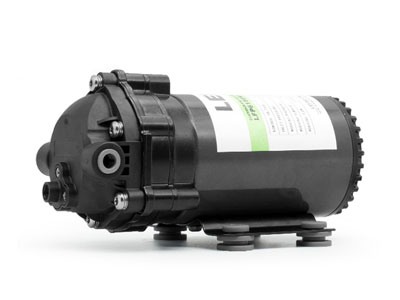
When selecting a peristaltic pump for an OEM machine or fluid handling system, voltage is one of the first specifications engineers need to confirm. Both 12V and 24V pumps can provide reliable liquid transfer and dosing, but the better choice depends on the power architecture of the equipment, the motor and control method, and the required operating conditions.
It is important to understand that a 24V peristaltic pump is not automatically faster, more accurate or more powerful than a 12V model. Voltage is only one part of the pump system. Flow performance is also influenced by pump head design, motor speed, tubing size, tubing material and the characteristics of the liquid being transferred.
For equipment designers, the practical goal is therefore not to choose the "higher" voltage, but to choose a pump that fits the machine electrically and performs reliably under the intended operating conditions.
12V vs. 24V Peristaltic Pump: What Are the Key Differences?
The most obvious difference is the required DC supply. A 12V pump is designed for a 12V electrical system, while a 24V pump is intended to operate from a compatible 24V supply. This affects how the pump is integrated into the machine and how its motor and control electronics are selected.
For comparable electrical power, a 24V system can operate with lower current than a 12V system. This can be useful when designing the electrical architecture of equipment, but it does not mean that every 24V pump will outperform every 12V pump.
LEFOO's own product specifications illustrate this point. Several LEFOO DC motor peristaltic pump models are available with both 12V and 24V options, while their published flow ranges are defined together with factors such as tubing dimensions and materials rather than voltage alone.
| Consideration | 12V Peristaltic Pump | 24V Peristaltic Pump |
|---|
| Power supply | Best matched to 12V systems | Best matched to 24V systems |
| Equipment integration | Suitable when 12V DC is already available | Suitable when the machine uses 24V DC |
| Current demand | Higher at comparable electrical power | Lower at comparable electrical power |
| Flow capability | Depends on pump, speed and tubing | Depends on pump, speed and tubing |
| Typical selection priority | Power compatibility and compact integration | Power compatibility and OEM/automation integration |
The main takeaway is simple: voltage should be selected according to the equipment design, not used as a shortcut for judging pump performance.
How Does Supply Voltage Affect Peristaltic Pump Performance?
Supply voltage primarily affects the motor and electrical side of the pump. A motor should operate within the voltage range specified for that particular model. Supplying the wrong voltage can result in poor operation or may damage components when the pump and driver are not designed for that input.
However, the amount of liquid delivered by a peristaltic pump is determined by more than supply voltage.
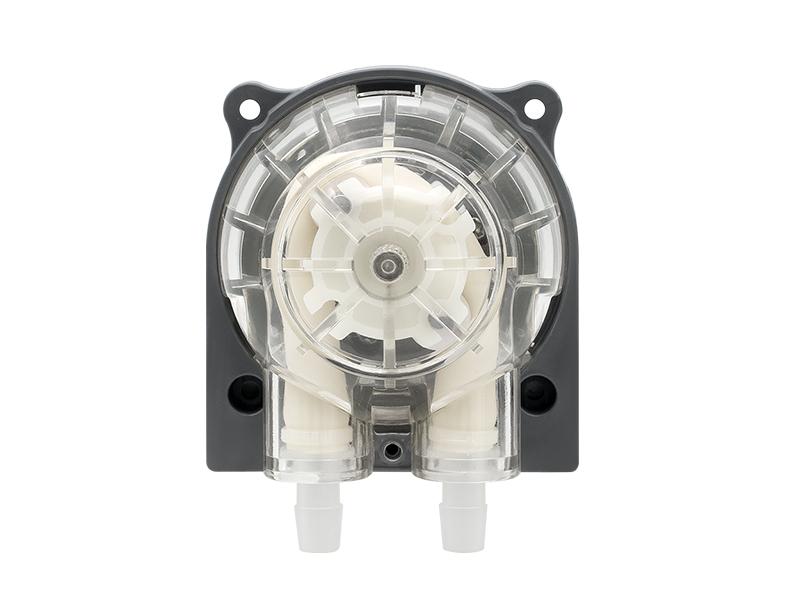
As the motor rotates, rollers compress the flexible tube and move a defined volume of liquid forward. The resulting flow is therefore closely related to motor speed, tubing dimensions and pump-head geometry. Fluid viscosity, discharge conditions and tube compression can also affect real operating results.
This is why two pumps operating at 24V can have very different flow ranges.
For example, LEFOO's LFP102/DB is offered in 12V/24V configurations with published flow ranges that vary according to tube size and material. The LFP501DB is also available in 12V DC or 24V DC versions and is designed for substantially higher-flow liquid transfer applications.
For OEM engineers, this means voltage should be checked first for electrical compatibility, followed by the actual performance specifications of the selected pump model.
When Should You Choose a 12V Peristaltic Pump?
A 12V peristaltic pump is a logical choice when the host equipment already uses a 12V DC power architecture.
Keeping the pump compatible with the existing supply can simplify integration because there may be no need to add a separate voltage conversion stage simply to operate the pump. This is particularly useful in compact machines where the power system has already been designed around a 12V source.
The required flow should still be checked independently. A 12V specification does not automatically indicate a low-flow pump. The motor, gearbox, pump head and tubing combination ultimately determine whether the selected model can meet the application's dosing or transfer requirement.
LEFOO offers several DC motor peristaltic pumps with 12V/24V options. For example, the LFP203/DB supports both voltages and provides different published flow ranges according to its hose configuration.
A 12V model is therefore worth considering when:
the machine already provides a suitable 12V DC supply;
its required flow range matches an available 12V pump configuration;
the motor and control requirements fit the equipment design.
Instead of changing the machine architecture around the pump, OEM designers can often achieve a cleaner integration by selecting a pump designed for the voltage already available.
When Is a 24V Peristaltic Pump the Better Choice?
A 24V peristaltic pump becomes the more practical option when the equipment is already designed around a 24V DC supply or when the selected pump and control configuration specifically requires 24V.
This can be especially relevant in automated equipment where the pump needs to work as part of a larger control system rather than as an isolated component. In these cases, voltage compatibility should be considered together with motor type, speed regulation and the machine's control strategy.
The distinction becomes particularly important when comparing DC motor and stepper motor solutions. LEFOO offers DC motor models with 12V/24V options, while certain stepper motor pumps are specified for 24V operation. For example, the LFP302/ST is a 24V stepper motor peristaltic pump with flow ranges that vary according to the tubing configuration.
A 24V configuration may therefore make more sense when:
the host equipment already provides 24V DC;
the selected motor or control solution is designed for 24V;
the pump must be integrated into an automated dosing or liquid-transfer system.
The important distinction is that 24V is an integration choice, not a guarantee of higher flow or better accuracy.
If you are developing equipment that requires a DC or stepper motor pump, you can explore the broader LEFOO product range to compare pump configurations for different fluid handling requirements.
How to Choose Between a 12V and 24V Peristaltic Pump for Your Equipment
A good selection process starts with the machine rather than the pump catalogue.
First, confirm what DC voltage is already available inside the equipment. If the machine is built around 12V, a compatible 12V pump may simplify integration. If a stable 24V supply is already available, a 24V model may be the more natural choice.
Next, define the required flow range. This immediately narrows the suitable pump-head, motor and tubing combinations. Avoid assuming that voltage alone tells you how much liquid the pump can deliver.
The fluid itself also matters. Because the liquid in a peristaltic pump travels through flexible tubing, tube selection should be evaluated according to the fluid and the operating environment. LEFOO publishes different flow specifications for different tube sizes and materials on individual pump models, showing why the tubing configuration should be considered during pump selection.
Finally, consider how the pump needs to be controlled. A straightforward liquid-transfer function may have different motor requirements from equipment that needs adjustable speed, repeatable dosing or integration with an external control system.
For OEM projects, these factors are best evaluated together:
equipment voltage → required flow → fluid and tubing → motor/control method → final pump configuration
This approach helps avoid a common mistake: selecting a pump because its voltage appears suitable before confirming whether the complete configuration can deliver the required performance.
Conclusion
There is no universal winner in the 12V vs. 24V peristaltic pump comparison.
A 12V pump is often the most practical solution when the equipment already operates from a 12V DC supply. A 24V peristaltic pump is a better fit when the machine uses 24V or when the selected motor and control configuration is designed around that voltage.
In both cases, voltage should be treated as one selection factor rather than the main measure of pump performance. Flow requirements, tubing, motor type and equipment control need to be considered together before the final model is specified.
LEFOO provides different peristaltic pump configurations for OEM dosing and fluid-transfer applications, including DC motor and stepper motor solutions. If you are evaluating a pump for a new machine or need help matching a pump configuration to your operating requirements, contact LEFOO to discuss your application.
FAQs About 12V and 24V Peristaltic Pumps
1. Is a 24V peristaltic pump more powerful than a 12V pump?
Not necessarily. Voltage alone does not determine pump performance. Flow and operating capability also depend on the motor, pump head, speed, tubing and application conditions.
2. Can I replace a 12V peristaltic pump with a 24V model?
Only if the equipment power supply and control system are compatible with the new pump. Always confirm the specified operating voltage before replacement.
3. Does a 24V peristaltic pump provide a higher flow rate?
Not automatically. Pumps with the same voltage can have very different flow ranges. The complete pump and tubing configuration determines the actual flow capability.
4. What information should I provide when selecting a 12V or 24V peristaltic pump?
Start with the available supply voltage, required flow range, fluid characteristics and desired control method. These details make it much easier to identify a suitable pump configuration.
 English
  français
  Deutsch
  Español
  italiano
  русский
  português
  العربية
  Türkçe
  Zulu
Zulu