In the world of fluid handling, the peristaltic pump is a cornerstone of reliability, prized for its ability to transport media without contamination. However, once you decide on a peristaltic pump, you face a critical design choice: the drive technology. Whether you select a standard DC-driven unit or a high-precision stepper peristaltic pump can fundamentally change how your system operates, how much it costs, and how long it lasts. Understanding which technology aligns with your specific project requirements is the difference between a high-efficiency operation and a maintenance nightmare.
Understanding Your Fluid Transfer Needs: Precision vs. General Transfer
Before diving into hardware specifications, you must define the primary mission of your fluid handling system. Are you performing high-speed, continuous transfer of cooling fluids, or are you executing a delicate titration process that requires microliter-level accuracy?
Fluid transfer tasks generally fall into two categories:
General Transfer: Applications that focus on volume throughput, such as basic water circulation, coolant pumping, or simple tank-to-tank liquid movement. In these scenarios, slight variations in flow rate are often acceptable.
Precision Dosing: Applications that demand exact, repeatable volumes, such as chemical reagent addition, medical dosing, or pharmaceutical packaging. Here, the drive motor must be capable of precise starting, stopping, and speed regulation.
Selecting the wrong drive for your application is a common pitfall. For instance, attempting to use a low-cost, voltage-controlled DC pump for a high-precision lab experiment will likely result in inconsistent dosing, leading to errors in chemical reactions or product batches.
DC Motor Pumps: Ideal Scenarios for Cost-Effective Fluid Handling
DC motor peristaltic pumps are the "workhorses" of the industry. They rely on varying input voltage (for brushed motors) or PWM signals (for brushless DC motors) to control speed. Because their design is relatively simple, they are the preferred choice for projects where budget is a priority and the requirement for absolute volume precision is secondary.
For many industrial designers, the DC motor pump is the go-to solution for:
Space-Constrained Devices: DC motors are typically more compact than their stepper counterparts, making them ideal for portable medical devices or desktop lab equipment.
Simple Pumping Tasks: They excel in applications like soap dispensing in commercial restrooms, small-scale liquid cooling systems, or simple drainage operations where the primary goal is moving a fluid from Point A to Point B.
Lower Initial Investment: When you need to scale up a production run of a product, the lower unit cost of a DC-driven pump significantly improves the overall project ROI.
While they are highly effective, it is important to note that DC motor performance can drift as the pump tube wears or if the load on the pipe changes, as they lack the "locked-in" speed control found in more advanced drives.
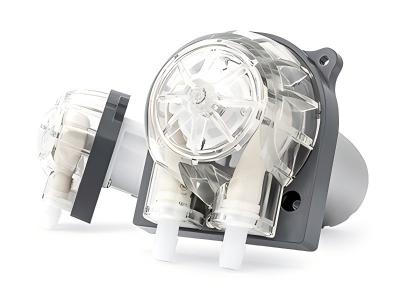
Stepper Motor Pumps: Why Precision Is Key for Automated Industrial Processes
When your application requires high-level control—such as the ability to stop at an exact milliliter or maintain a constant flow regardless of pressure changes—the stepper peristaltic pump becomes indispensable. A stepper motor works by dividing a full rotation into a series of discrete "steps." By sending a precise number of pulses from a PLC or controller, you can control the output with mathematical exactness.
The advantages of a stepper peristaltic pump are particularly evident in automated environments:
Repeatability: Because the motor moves in discrete steps, it provides the same volume output every time. This is critical for industrial dosing systems where even a 2% deviation could compromise a chemical batch.
Integration with Automation: These pumps speak the language of modern industry. They integrate seamlessly with PLCs, allowing for complex programming of flow rates, pause intervals, and ramp-up/ramp-down sequences.
Stability Under Load: Unlike DC motors, which may slow down if the back-pressure increases, a properly configured stepper system maintains its speed to ensure a steady output.
If your facility relies on complex automation, consider looking at our Lefoo products to see how our engineered solutions integrate with these high-performance drives.
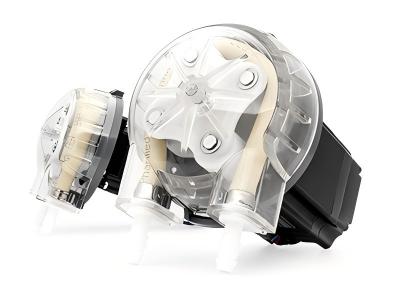
System Integration and Environmental Constraints in Modern Facilities
Integrating a pump into a larger system requires more than just picking a motor; you must consider the electrical and environmental constraints of your facility. A DC motor pump is generally "plug and play." You provide a voltage source, and the pump runs—it is simple, robust, and requires very little electrical overhead. In contrast, a stepper peristaltic pump requires a driver board or a motion controller to convert digital pulses into motor motion. While this adds a layer of complexity to your hardware design, it also grants you complete control over your fluid handling processes. Consider these trade-offs as you design your system:
| Feature | DC Motor Driven Pump | Stepper Motor Driven Pump |
|---|
| Control Signal | Voltage/PWM | Pulse/Direction (Digital) |
| Complexity | Minimal | Moderate (Requires driver) |
| Dosing Accuracy | Variable (medium) | Excellent (high) |
| Energy Profile | Variable | Constant/Controlled |
| Installation | Immediate/Simple | System-Integrated |
Furthermore, consider the noise and vibration profile of your environment. Stepper motors are highly efficient, but they do generate a characteristic "hum" or vibration during stepping, which may require dampening mounts in noise-sensitive laboratory environments. DC pumps, particularly brushless DC (BLDC) models, offer a much quieter, smoother operation profile, which might be preferable for office or healthcare-based equipment.
Matching the Right Pump Technology to Your Project Goals
The process of matching the technology to the goal involves a holistic look at the project. Are you building a long-term, high-output industrial chemical line, or are you developing a low-cost, disposable, or small-scale laboratory tool?
If your goal is to minimize maintenance and maximize precision over a five-year operation cycle, the stepper peristaltic pump is the clear winner. Its ability to provide feedback and maintain control ensures that you spend less time on recalibration. Conversely, if your goal is a quick-to-market, cost-effective consumer product, a DC motor solution provides the necessary performance without the added weight and cost of pulse-based control systems.
Lefoo has spent years perfecting both drive technologies to support diverse industrial needs. Our comprehensive instrumentation solutions are designed to work in tandem to create a truly smart, monitored fluid system. We understand that your project's success is tied to the reliability of these small but critical components. If you find yourself at a crossroads between these two technologies, our technical support team is ready to analyze your flow requirements, chemical compatibility needs, and integration constraints to recommend the ideal solution.
Conclusion
Choosing between a DC-driven peristaltic pump and a stepper peristaltic pump is not about finding the "better" motor—it is about identifying the right tool for your specific application. DC motors offer a cost-effective, simple, and compact solution for general liquid transfer tasks where simplicity is paramount. On the other hand, the stepper peristaltic pump offers the precision, repeatability, and automation-readiness required for modern industrial dosing and complex fluid management. By carefully assessing your precision requirements, system integration complexity, and long-term project goals, you can ensure that your fluid handling infrastructure is as efficient and reliable as possible.
FAQ
While possible with external sensors, a DC pump lacks the inherent precision of a stepper motor; therefore, it is generally not recommended for applications requiring exact volumetric control.
A stepper pump requires a dedicated controller or driver board that can send pulse/direction signals to control the motor's position and speed accurately.
Brushless DC (BLDC) pumps are typically quieter and smoother in operation, making them a better choice for noise-sensitive laboratory settings compared to standard stepper motors.
Because a stepper motor provides discrete, controlled motion, it reduces unnecessary stress on the pump tubing and components compared to DC motors, which may fluctuate in speed and load, ultimately extending the service life of the entire pump assembly.
 English
  français
  Deutsch
  Español
  italiano
  русский
  português
  العربية
  Türkçe
  Zulu
Zulu