In the world of residential and commercial water treatment, the reverse osmosis (RO) system is the gold standard for purity. Yet, the effectiveness of any RO unit is only as strong as the pressure driving it. Many homeowners and facility managers find that their systems suffer from low flow rates, excessive wastewater, or poor water quality, often unaware that the culprit is inadequate feed pressure. This is where a high-performance water purifier booster pump becomes the vital engine of your system. Understanding what separates a reliable, long-lasting pump from a failing one is essential for maintaining water quality and operational efficiency.
The Core Function: Why Pressure is the Heart of Your RO System
Reverse osmosis is fundamentally a pressure-driven application. To force water molecules through a semi-permeable membrane while leaving contaminants behind, you need consistent, sustained force. If your municipal water pressure is lower than the requirements of your membrane—typically falling below 45 psi—the system struggles to function correctly.
When feed pressure is insufficient, the osmosis process is compromised, resulting in a higher ratio of rejected water and a significantly lower production of clean, drinkable water. By integrating a water purifier booster pump, you effectively "awaken" the system. A reliable pump raises the operating pressure to the optimal 75–100 psi range. This increase in pressure is directly proportional to the efficiency of the RO system; it not only increases the volume of pure water produced but also often lowers the Total Dissolved Solids (TDS) in the product water by ensuring the membrane operates within its ideal performance parameters.
Essential Technical Specifications for Peak Performance
When selecting a water purifier booster pump, you are essentially choosing the "heart" of your purification setup. To ensure peak performance, you must look beyond brand names and focus on specific technical metrics. Most residential RO systems operate on 24VDC, a standard that offers the best balance between power, safety, and energy efficiency.
To help you understand the requirements for different setups, consider these benchmarks for pump selection:
| RO Capacity | Typical Required Pressure | Typical Input Voltage |
|---|
| 50 GPD Systems | 70–80 psi | 24VDC |
| 75 GPD Systems | 80–90 psi | 24VDC |
| 100+ GPD Systems | 90–100 psi | 24VDC |
Beyond these specs, a truly reliable pump should offer self-priming capabilities. This feature is particularly valuable if your water source is not pressurized or if the system needs to pull water from a static storage tank, ensuring the pump can start reliably without the risk of airlocks that could damage the motor.
Materials and Build Quality: Indicators of Long-Term Reliability
Reliability is a byproduct of high-quality engineering and material choice. Since a water purifier booster pump is in constant contact with water and operates under significant internal strain, the materials used in its construction are non-negotiable.
A reliable pump should utilize high-grade, corrosion-resistant components. Look for reinforced housings that can withstand the mechanical stress of constant pressurization. Furthermore, the internal seals and membranes must be compatible with the water chemistry of your region. Pumps built with poor-quality plastic or substandard rubber seals are prone to micro-leaks, which not only waste water but can lead to electrical shorts within the motor housing. A reliable pump is also designed with thermal management in mind; the motor should be able to dissipate heat effectively to prevent degradation during long cycles of operation, which is a common occurrence in high-demand residential or light commercial settings.
Assessing Operational Stability: Noise, Vibration, and Efficiency
One of the most noticeable differences between a budget pump and a high-quality unit is operational stability. A reliable water purifier booster pump should run with minimal noise and vibration. Excessive vibration is more than just a nuisance; it is a symptom of poor internal alignment and unbalanced rotating components. Over time, this mechanical "chatter" can loosen pipe fittings, cause leaks, and contribute to premature failure of the RO membrane itself.
Efficiency is equally important. An efficient pump delivers the required pressure while consuming the least amount of electricity possible. In modern systems, this means using precision-engineered motors that do not "struggle" to reach the target psi. If you find your pump running for extended periods, constantly cycling, or producing high-frequency electrical hums, it is likely lacking the efficiency required for stable long-term use. Stable, quiet operation is the hallmark of a pump that is built to endure millions of cycles.
Choosing the Right Pump for Your Filtration Capacity
Not all pumps are designed for every system. A major mistake users make is "over-pumping" or "under-pumping" their RO membrane. A pump designed for a 50 GPD (Gallons Per Day) system might burn out if forced to drive a 400 GPD unit, while a pump too powerful for a small unit can stress the membrane and cause frequent relief valve activations.
You must match the pump’s GPD rating to your RO system’s requirements. If your system is an upgrade, ensure the water purifier booster pump you choose is compatible with the membrane's rating. Furthermore, consider the physical form factor. In residential under-sink systems, space is often at a premium, so a compact, well-integrated design is often superior to a bulky unit. Always consult your RO system’s manual for the manufacturer’s recommended pressure range, and ensure the pump you select can handle that specific load consistently.
Quality Engineering in Practice: The Lefoo Commitment
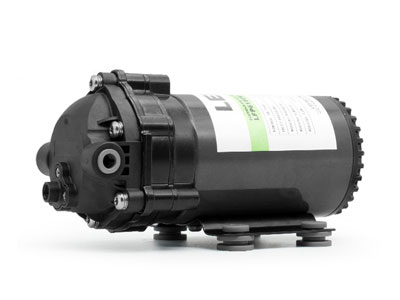
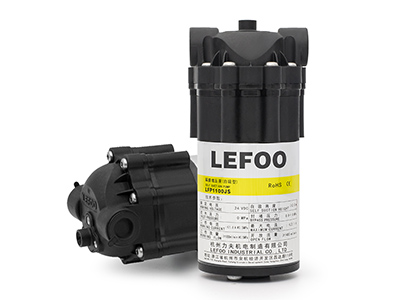
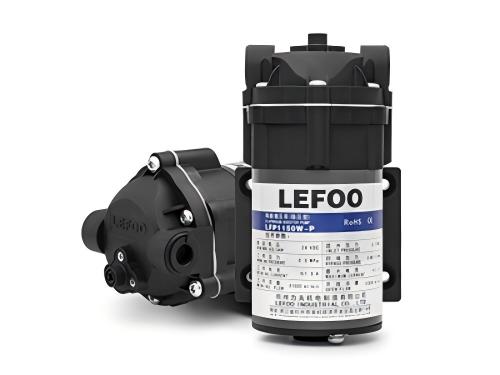
At Lefoo, we recognize that a water purifier booster pump is a critical component that users depend on for clean drinking water. Our approach to design is rooted in practicality and modularity. For instance, our LFP1075 series is specifically engineered for 75 GPD water purifiers, offering high-performance self-priming capabilities that allow for reliable water transfer even from static sources.
We have diversified our designs to cater to different operational needs without compromising on quality:
LFP1075J: A residential booster pump designed for space-constrained environments, offering a smaller footprint without sacrificing pressure performance.
LFP1075S-P: An economic version that retains the core reliability of our series, providing a cost-effective solution for standard household setups.
LFP1075W: Featuring adjustable pressure settings, this model is ideal for users who need fine-tuned control over their RO output.
By focusing on these specific engineering refinements, we ensure that every pump provides the consistent 75–100 psi required for high-quality filtration. You can explore our full range of solutions by visiting our products page.
Conclusion
A reliable water purifier booster pump is not merely an accessory; it is the fundamental driver of your reverse osmosis system’s performance. By ensuring your system maintains the correct pressure, you protect the longevity of your RO membrane, improve water quality, and drastically reduce wastewater. When selecting a pump, prioritize build quality, operational stability, and precise technical matching. Whether you require a compact residential unit or an adjustable pressure system, choosing a pump engineered for durability will save you time, energy, and maintenance costs in the long run. If you are uncertain about the specific requirements for your current system, our technical team is here to help you navigate your options and find the perfect match. You can reach out to us for detailed guidance at our contact page.
FAQ
It is likely due to low feed water pressure. If your supply is below 45 psi, the RO membrane cannot function efficiently, and a booster pump is required to restore flow.
Most residential RO systems can accommodate a booster pump, provided you have a 24VDC power source and the pump GPD rating matches your membrane capacity.
With proper installation and by avoiding continuous "dry-run" operation, a high-quality booster pump should provide years of service, depending on the volume of water processed daily.
Adjustable pumps (like our LFP1075W) allow you to calibrate the output pressure to match the specific requirements of your membrane and local water conditions, optimizing efficiency and water quality.
 English
  français
  Deutsch
  Español
  italiano
  русский
  português
  العربية
  Türkçe
  Zulu
Zulu