English
 français
 Deutsch
 Español
 italiano
 русский
 português
 العربية
 Türkçe
 Zulu

An 800 GPD pump may be sufficient for one RO system, while another needs the working flow of a 1000 or 1200 GPD model. The difference depends on the membrane configuration, recovery rate and pressure required during filtration.
For equipment manufacturers comparing these three capacities, the useful question is straightforward: how much feedwater can each pump deliver at the required operating pressure? Voltage, current demand, connections and operating hours then determine whether that pump fits the equipment.
This guide compares the three options, with a closer look at when a 1000 GPD RO booster pump is appropriate and what to check before moving to a larger model.
What Does the GPD Rating Mean on an RO Booster Pump?
GPD means gallons per day. In RO equipment, it commonly describes the nominal daily permeate production of the membrane or system under specified conditions. On a pump listing, it indicates the intended RO capacity class; it should not be read as a direct measurement of pump delivery.
A booster pump ro 1000 gpd listing therefore needs to be checked against its working-flow specification. The pump supplies both the water that passes through the membrane as permeate and the water discharged as concentrate.
Two pumps carrying the same GPD label can have different pressure–flow characteristics, current requirements or connections. Compare their actual specifications before treating them as interchangeable.
800 vs. 1000 vs. 1200 GPD: Product Specification Comparison
The following table summarizes LEFOO’s published product information. Values vary by model within each capacity group, so confirm the exact model and test conditions before ordering.
| Comparison Item | 800 GPD | 1000 GPD | 1200 GPD |
|---|---|---|---|
| Listed DC voltage options | 24V or 36V, depending on model | 36V | 36V |
| Listed working-flow minimums | 3.5 or 4.0 L/min | 4.5 or 5.0 L/min | 5.5 L/min |
| Listed inlet pressure | 0.2 MPa | 0.2 MPa | 0.2 MPa |
| Listed working pressure | 0.7 MPa | 0.7 MPa | 0.7 MPa |
| Main selection question | Does the lower-flow option meet the complete feed requirement? | Does its working flow match the intended 1000 GPD system? | Does the system require the additional working flow? |
These are published specification points, not complete performance curves. Ask the supplier to confirm flow at your actual inlet and discharge conditions, including whether pressure values refer to discharge pressure or pressure rise across the pump.
When Should You Consider an 800 GPD RO Booster Pump?
An 800 GPD model is worth evaluating when the required feed flow falls within its verified operating capability. This may apply to a lower-output RO configuration or an existing system designed around that pump class.
Before choosing it, confirm:
The required membrane feed flow at the planned recovery rate.
Available pump flow at the necessary operating pressure.
The inlet pressure after pretreatment and filter losses.
Compatibility with the installed 24V or 36V power supply.
A lower capacity label does not prove lower energy consumption or lower total cost. Compare electrical input at the required operating point, expected run time and the cost of any supporting components.
When Is a 1000 GPD RO Booster Pump the Right Choice?
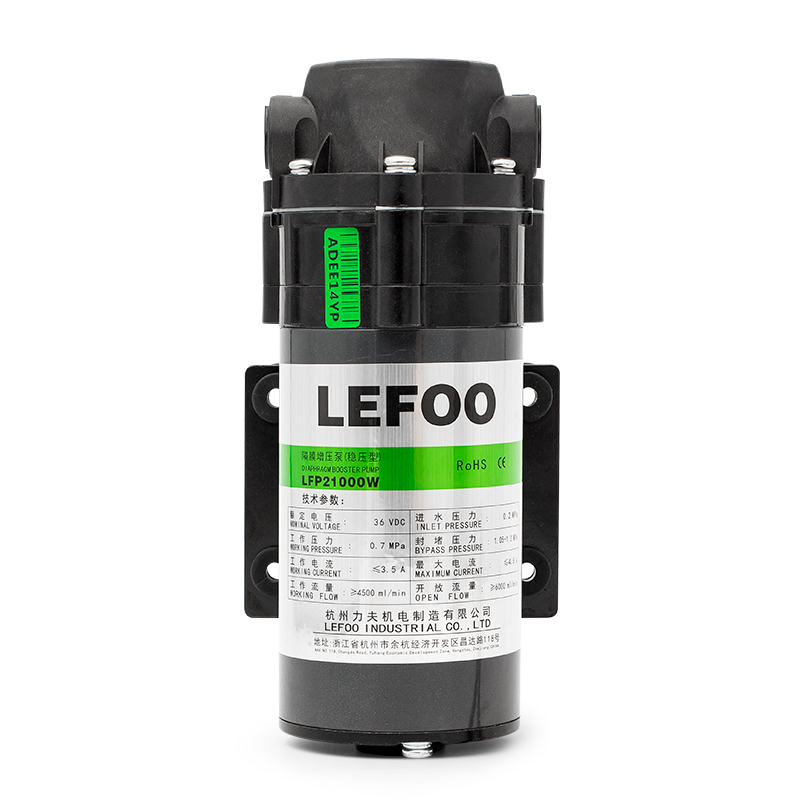
A 1000 GPD RO booster pump is a candidate when its pressure–flow performance matches the feed requirement of the intended membrane arrangement. It should be evaluated against the complete system rather than selected simply because the membrane also says 1000 GPD.
For a single-pass system without concentrate recirculation:
Required feed flow = Target permeate flow ÷ Recovery rate
Using US gallons and continuous operation, a nominal 1000 GPD permeate output is approximately 2.63 L/min. The feed requirement changes with recovery:
| Illustrative Recovery | Target Permeate Flow | Required Feed Flow |
|---|---|---|
| 40% | 2.63 L/min | Approximately 6.57 L/min |
| 50% | 2.63 L/min | Approximately 5.26 L/min |
| 60% | 2.63 L/min | Approximately 4.38 L/min |
These are calculation examples, not recommended recovery settings. The membrane supplier must establish acceptable recovery based on membrane limits, feedwater chemistry and concentrate-flow requirements.
The examples explain why capacity labels alone are insufficient. A 5.0 L/min pump operating point would fall short of the approximately 5.26 L/min feed requirement in the 50% example. A stated minimum flow also does not establish a pump’s maximum capability; obtain the actual curve or verified test data.
Review the available configurations on LEFOO’s booster pump RO 1000 GPD page, then confirm the selected model against the membrane datasheet and operating conditions.
When Should You Consider a 1200 GPD RO Booster Pump?
Consider a 1200 GPD model when the system requires more feed flow than the evaluated 800 or 1000 GPD options can provide at the required pressure.
Possible reasons include a higher permeate-production target, a different membrane arrangement or a lower approved recovery rate that increases feed demand. Each requires a fresh hydraulic and electrical check.
A larger pump does not automatically increase membrane output. The result still depends on pressure, temperature, feedwater salinity, membrane condition and system restrictions.
Before upgrading, confirm that:
The membrane and housing remain within their operating limits.
The concentrate-flow control is appropriate for the new operating point.
Pretreatment and inlet plumbing can supply the required flow.
The power supply, wiring and controller can support the selected pump.
Pressure protection and shutoff controls function correctly.
Use LEFOO’s 1200 GPD RO booster pump specifications to assess the larger-flow option. Confirm compatibility before using it as a replacement in an existing system.
Compare the Complete Installation Before Making a Decision
Once the hydraulic requirement is clear, compare the practical differences between suitable models.
| Selection Factor | What to Check |
|---|---|
| Working flow and pressure | Verified delivery at the intended operating point |
| Electrical supply | Voltage, running current, startup demand and controller compatibility |
| Installation | Mounting dimensions, connector type, tubing routes and service access |
| Operating cycle | Daily run time, starts per hour and manufacturer-specified duty limits |
| Water conditions | Temperature, salinity, pretreatment and available inlet pressure |
| Validation | Measured feed flow, permeate flow, recovery, current and pressure |
When comparing diaphragm booster pumps, provide the supplier with one consistent set of application conditions. This makes quotations and performance data easier to compare.
After installation, measure feed, permeate and concentrate flows together. Record water temperature, pressure and current so any difference from the target output can be investigated using actual operating data.
FAQs About 800, 1000 and 1200 GPD RO Booster Pumps
Can an 800 GPD pump work with a 1000 GPD membrane?
Only if its verified flow at the required pressure meets the membrane’s feed requirement. Confirm compatibility with both suppliers rather than relying on the labels.
Will a 1200 GPD pump make a 1000 GPD membrane produce more water?
Not necessarily. Additional pump capacity may not improve output if another factor limits production. Check membrane limits and the complete system operating point before changing pumps.
Does a 1000 GPD RO booster pump deliver 1000 gallons of purified water per day?
The pump supplies feedwater. Purified-water production depends on the membrane, recovery and operating conditions; the pump’s GPD label is not a guaranteed system output.
Are all three capacities compatible with the same power supply?
No. Voltage and current requirements vary by model. Confirm the selected pump’s electrical requirements, including startup demand, before reusing an existing supply.
Should I choose the largest pump to allow for future expansion?
Only after checking the planned future system and the present operating point. Extra capacity must remain compatible with the membrane, controls, power supply and plumbing.
What information is needed for a pump recommendation?
Provide the membrane model, target output, recovery, feedwater conditions, inlet pressure, required working pressure, power supply and expected operating hours.
Find the Right RO Booster Pump for Your Equipment
Comparing 800, 1000 and 1200 GPD options? Send LEFOO your membrane datasheet, target production and operating requirements to discuss a suitable pump configuration.
For a 1000 GPD project, include the calculated feed flow, intended recovery, available inlet pressure, power supply and connection requirements. These details help establish whether a 1000 GPD model fits or another capacity should be evaluated.
Email lefoogroup@lefoo.com to discuss pump selection for your RO equipment.