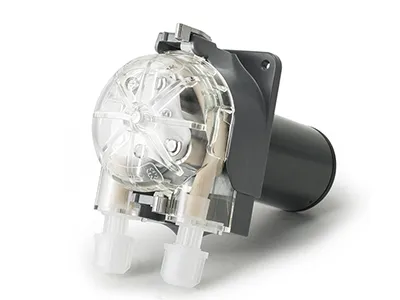
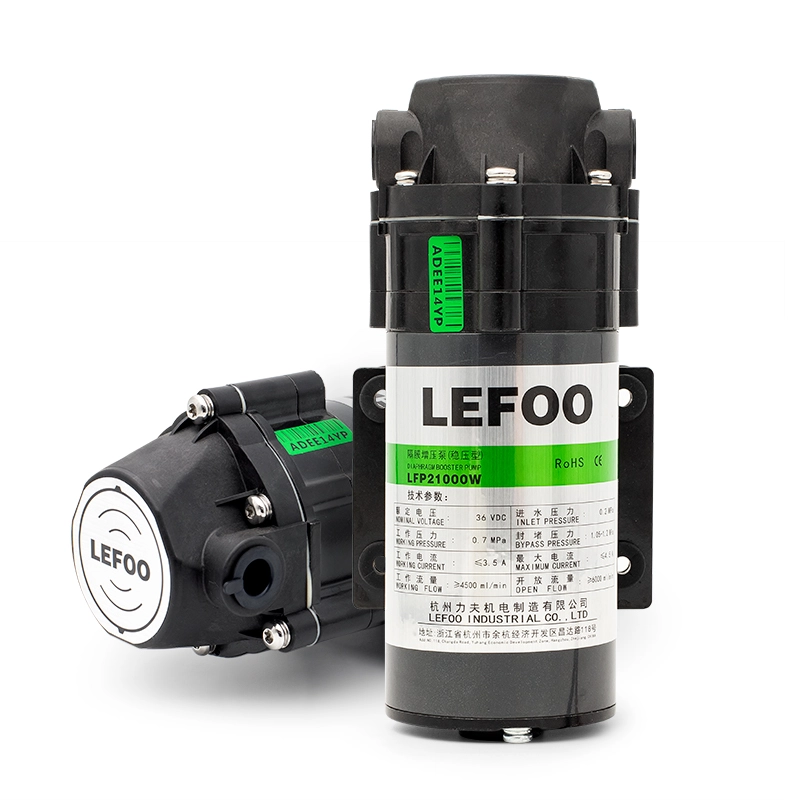
Peristaltic pumps are widely used in water treatment equipment, laboratory instruments, medical devices, and industrial fluid-handling systems. Their ability to move liquid through flexible tubing makes them useful for applications requiring controlled flow and isolation between the fluid and most pump components.
However, selecting a reliable peristaltic water pump requires more than checking its maximum flow rate. Tubing dimensions, pump-head geometry, motor performance, and fluid compatibility all influence dispensing accuracy, operating life, and system reliability.
This guide explains the key elements of peristaltic pump design, how to select a suitable peristaltic pump motor, and what engineers should evaluate when integrating a pump into their equipment.
How Does Peristaltic Pump Design Affect Performance?
A peristaltic pump moves liquid by repeatedly compressing flexible tubing. Rollers or shoes press against the tube, creating a moving occlusion that pushes liquid toward the outlet. When the compression point moves forward, the tubing recovers and draws additional liquid into the pump.
Because the liquid primarily contacts the tubing, this design can reduce contamination risks and simplify fluid-path maintenance.
Several design parameters influence pump performance.
Pump-head geometry: The number of rollers, rotor diameter, and tubing path affect displacement per revolution, pulsation, and mechanical loading.
Tubing dimensions: Inner diameter, wall thickness, and elastic recovery influence flow rate, compression force, and tube fatigue.
Compression setting: Insufficient compression may allow backflow, while excessive compression can increase motor load and accelerate tubing wear.
Motor speed: Rotor speed directly affects flow, but the relationship depends on tubing dimensions, pump geometry, and operating conditions.
A well-designed pump balances flow requirements, repeatability, tubing life, and energy consumption rather than maximizing a single parameter.
How to Choose the Right Tubing for a Peristaltic Water Pump
Tubing is one of the most important components in a peristaltic water pump because it forms the main fluid-contact surface and undergoes repeated mechanical deformation.
Tubing Material and Water Compatibility
Silicone tubing is commonly considered for applications requiring flexibility and repeated compression. Other elastomers and specialized tubing materials may be suitable when the application requires different chemical resistance, temperature limits, or permeability characteristics.
Before selecting a material, engineers should verify its compatibility with the actual liquid. Water containing disinfectants, cleaning agents, dissolved chemicals, or other additives may behave differently from clean water.
Material selection should also consider the intended operating temperature, required cleanliness, and applicable industry requirements.
Inner Diameter and Wall Thickness
The tubing inner diameter affects the volume of liquid displaced during each rotor revolution. Larger tubing can generally deliver more liquid per revolution, but it may also require a larger pump head and greater compression force.
Wall thickness influences the force needed to occlude the tube and its ability to recover after compression. An unsuitable combination can result in poor flow consistency, excessive motor load, or shortened tubing life.
Engineers should therefore select tubing according to the pump-head specification rather than assuming that any flexible tube will work.
Compression Fatigue and Service Life
Repeated compression gradually changes tubing properties. Depending on the material and operating conditions, the tube may develop permanent deformation, cracks, reduced elasticity, or leakage.
Tubing life is affected by rotor speed, compression level, temperature, fluid compatibility, and continuous operating time. Representative testing is necessary to establish a realistic replacement interval.
Selecting a Suitable Peristaltic Pump Motor
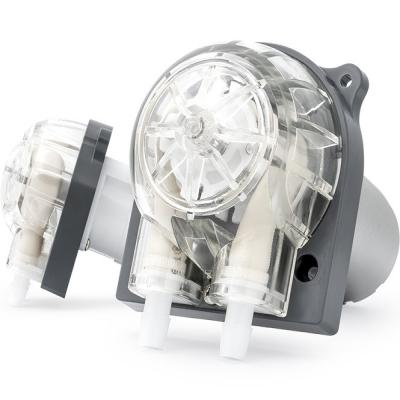
The peristaltic pump motor determines how the rotor operates under the mechanical load created by tubing compression and fluid resistance.
A motor should be selected according to the required speed range, torque, supply voltage, control method, and duty cycle.
Motor Speed and Flow Control
Increasing rotor speed generally increases flow, provided the tubing and pump head remain within their operating limits. However, higher speed may also increase pulsation, heat generation, and tubing fatigue.
For equipment requiring adjustable dispensing, engineers should evaluate whether the motor supports the required speed-control range and whether the controller can maintain stable operation under changing loads.
Torque and Startup Requirements
The motor must provide sufficient torque to compress the tubing and overcome the mechanical resistance of the pump head. Insufficient torque can lead to unstable rotation, reduced speed, or startup problems.
Selection should consider the actual pump-head configuration, tubing dimensions, and expected operating conditions rather than relying only on the motor's nominal power rating.
Brushed vs. Brushless DC Motors
Brushed DC motors can be suitable for cost-sensitive applications with relatively straightforward control requirements. Brushless DC motors may offer advantages in service life and electronic speed control, depending on the design.
The appropriate choice depends on operating hours, maintenance expectations, control precision, budget, and available installation space.
LEFOO offers a BLDC peristaltic pump for applications where brushless motor technology is relevant. Engineers should review the specific product specifications before deciding whether it meets their torque, speed, and control requirements.
How to Optimize Flow Rate and Dispensing Accuracy
The flow rate of a peristaltic pump depends on the volume displaced per revolution and the rotor speed. In practice, actual output can differ from theoretical displacement because of tubing elasticity, backpressure, fluid properties, and wear.
For accurate dispensing, engineers should calibrate the pump using the intended liquid and operating conditions.
A practical evaluation includes measuring the delivered volume over a defined period, repeating the test at different speeds, and recording variations between runs.
Backpressure is particularly important. Increased outlet resistance can affect tubing behavior and reduce the delivered flow. Air bubbles, changes in viscosity, and inconsistent tubing compression can also influence repeatability.
For applications requiring precise dosing, the complete pump assembly should be tested rather than evaluating the motor or tubing independently.
Common Peristaltic Pump Design Problems and Solutions
| Observed problem | Potential cause | Recommended check |
|---|
| Flow rate is lower than expected | Incorrect tubing size, excessive backpressure, or insufficient speed | Verify tubing dimensions, system resistance, and operating speed |
| Flow varies between cycles | Tubing wear, inconsistent compression, or air in the fluid line | Inspect the tubing and repeat flow calibration |
| Motor overheats | Excessive mechanical load or unsuitable operating conditions | Check torque requirements, compression, and duty cycle |
| Tubing wears prematurely | Excessive compression, high speed, or incompatible material | Review pump-head settings and tubing compatibility |
| Pump struggles to start | Insufficient startup torque or excessive mechanical resistance | Check motor capability and pump-head assembly |
These checks help identify likely causes, but the correct solution depends on the actual system configuration and test results.
FAQs About Peristaltic Pump Design and Selection
1. What determines the flow rate of a peristaltic water pump?
Flow rate depends on tubing dimensions, pump-head geometry, rotor speed, tubing recovery, and operating conditions. Actual output should be measured under representative system conditions.
2. How do I choose a peristaltic pump motor?
Consider the required speed range, torque, voltage, control method, operating hours, and mechanical load. The motor must be compatible with the selected pump head and tubing.
3. Which tubing material is best for water applications?
There is no universal best material. Selection depends on water composition, temperature, cleaning requirements, operating pressure, and the expected tubing replacement interval.
4. Does increasing motor speed always improve pump performance?
Increasing speed generally increases theoretical flow, but it can also increase pulsation, heat generation, and tubing wear. The pump should operate within its validated performance range.
5. How can manufacturers improve peristaltic pump service life?
Use compatible tubing, appropriate compression settings, suitable motor control, and realistic operating limits. Regular inspection and application-specific endurance testing help establish suitable maintenance intervals.
Conclusion
Reliable peristaltic pump design requires coordination between tubing material, pump-head geometry, and motor performance. For a peristaltic water pump, fluid compatibility and tubing durability are just as important as nominal flow rate.
Selecting the right peristaltic pump motor also helps ensure stable operation, appropriate torque, and controllable output. By validating the complete pump assembly under actual operating conditions, equipment manufacturers can improve dispensing consistency, reduce premature component wear, and develop more reliable fluid-handling systems.
 English
 français
 Deutsch
 Español
 italiano
 русский
 português
 العربية
 Türkçe
 Zulu