English
 français
 Deutsch
 Español
 italiano
 русский
 português
 العربية
 Türkçe
 Zulu

A 0.1 mL dispensing error may be acceptable when transferring several litres. In a 0.5 mL dose, it represents a 20% deviation. For small-volume dispensing, the amount delivered after each start and stop matters as much as the pump’s average flow rate.
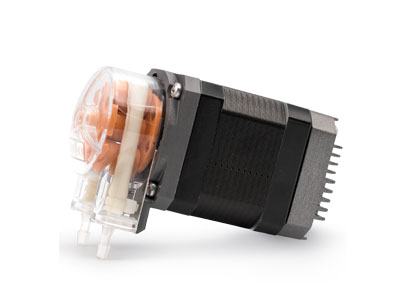
A peristaltic pump with stepper motor provides controlled motor movement for repeated dosing. However, motor positioning alone does not guarantee the delivered volume. Tubing dimensions, liquid properties, outlet conditions and calibration all affect what reaches the receiving container.
For equipment designers, the starting point is a clear dispensing requirement: the target volume, permitted error, available dispensing time and number of cycles.
Define Dose Volume and Dispensing Time Before Comparing Pumps
Low-flow pumping and small-volume dispensing are related but different requirements. A system may need a slow, continuous flow, or it may need a small dose delivered quickly followed by a long pause.
For an initial flow estimate:
Required average flow during dispensing = Dose volume ÷ Dispensing time
For example, dispensing 0.5 mL in 10 seconds requires an average flow of 3 mL/min during the dispense. Delivering the same volume in 30 seconds requires 1 mL/min. The dose is identical, but the required operating flow changes.
| Requirement | What to Specify |
|---|---|
| Dose volume | Minimum, normal and maximum volume per cycle |
| Dispensing time | Available delivery time, excluding pauses between cycles |
| Accuracy | Acceptable difference between the mean delivered dose and target |
| Repeatability | Acceptable variation between individual doses |
| Operating cycle | Doses per minute, pause duration and daily operating hours |
These requirements help distinguish a genuinely suitable low-flow model from a larger pump that can only approach the target by running for a very short time.
Understand What a Stepper Motor Controls
A stepper motor moves through commanded angular increments. In a peristaltic pump, this movement drives rollers that compress flexible tubing and move liquid toward the outlet.
The controller can use motor movement to establish a dispensing cycle. The resulting volume must still be measured because the liquid displaced per revolution depends on the pump head, tubing and operating conditions.
When evaluating a peristaltic pump with stepper motor, confirm the supported speed range, driver requirements, acceleration settings and control interface for the specific model.
Microstepping should not be treated as an equivalent increase in volumetric accuracy. It changes how the motor is driven; it does not remove tubing deformation, pressure effects, fluid pulsation or possible missed steps under excessive load.
Match the Tubing and Pump Head to the Required Dose
Tubing determines the liquid path and influences the volume displaced by the pump. A smaller internal diameter can help achieve lower delivery volumes, but it can also increase flow resistance and make inlet conditions more demanding.
Review the complete tubing configuration rather than selecting by diameter alone:
Internal diameter: affects displacement and flow resistance.
Wall thickness: must suit the pump head’s compression requirements.
Material: must tolerate the liquid, temperature and repeated compression.
Elastic recovery: influences how consistently the tube refills after compression.
Service condition: worn or permanently deformed tubing can change delivered volume.
For a low-flow application, choose a compatible pump-head and tubing combination that reaches the required operating range. Avoid assuming that the smallest available tube will provide the best result.
LEFOO’s range includes the LFP101A/ST, listed with a flow range of 0–1.4 mL/min. That published range provides a starting point for evaluation, but it does not establish a minimum accurate dose or a guaranteed dispensing tolerance. Request performance information for the intended tubing and liquid.
Control the Fluid Path from the Reservoir to the Nozzle
At small dose volumes, a bubble, a hanging droplet or a change in liquid level can become significant. Keep the fluid path consistent during calibration and operation.
Keep Inlet Conditions Consistent
Specify the reservoir’s position relative to the pump and the expected liquid-level range. Check for suction leaks, restrictions and bubbles. Prime the tubing using an approved procedure before measuring delivery.
Check Outlet Pressure and Tubing Resistance
A long outlet tube, narrow nozzle or pressurized receiving vessel can change the dispensing conditions. Test with the same tubing length, nozzle and outlet arrangement that the equipment will use.
Evaluate Dripping After the Motor Stops
Liquid remaining at the nozzle can affect the final dose. Assess nozzle geometry, outlet position and the time allowed before moving the receiving container.
Some dispensing systems use controlled reverse movement to reduce dripping. Confirm whether the selected pump and controller support this function, and validate the setting. Excessive reverse movement may introduce air or alter the following dose.
Calibrate the Pump Under Actual Dispensing Conditions
Calibration establishes the relationship between the commanded dispense and the measured output. Use the intended liquid, tubing, nozzle, operating speed and pressure conditions.
Install and prime the fluid path, removing visible bubbles.
Condition new tubing according to the supplier’s instructions.
Run a defined series of dispensing cycles.
Measure delivered volume or mass using suitable equipment.
Calculate the mean dose and compare it with the target.
Adjust the dispensing command and repeat the measurement.
When weighing doses, convert mass to volume using the liquid’s density at the relevant temperature. Ensure the balance has sufficient resolution for the required tolerance.
For very small doses, weighing a group of dispenses can help estimate the average delivery. However, this does not reveal variation between individual doses. Measure individual doses as well when repeatability is an acceptance requirement.
Repeat calibration after changing tubing size or material, liquid formulation, nozzle arrangement or other conditions that affect delivery.
Verify Accuracy and Repeatability Across the Operating Cycle
A pump can deliver consistent doses that are all slightly above the target. It can also achieve the correct average while individual doses vary too widely. Check both mean error and dose-to-dose variation.
Mean dose error (%) = (Mean measured dose − Target dose) ÷ Target dose × 100
For repeatability, record the spread of individual measurements. Standard deviation or coefficient of variation can support comparison when appropriate, but the acceptance method should follow the application’s requirements.
| Test Condition | What It Helps Evaluate |
|---|---|
| First dose after a long pause | Drain-back, nozzle condition and restart behavior |
| Repeated doses at normal speed | Typical dose accuracy and repeatability |
| Minimum and maximum dose settings | Performance across the required dispensing range |
| Changing reservoir level | Sensitivity to inlet conditions |
| New and used tubing | Calibration drift and maintenance requirements |
Before ordering a peristaltic pump, ask the supplier to test your target dose with the liquid and tubing you plan to use. Check both the average volume delivered and the variation between doses.
FAQs About Stepper Motor Peristaltic Pumps
Is a peristaltic pump with stepper motor suitable for small-volume dispensing?
It can be, provided the pump head, tubing, driver and operating range suit the required dose. Confirm performance through calibration and repeated-dose testing.
What is the minimum volume a stepper peristaltic pump can dispense?
There is no universal minimum. It depends on the pump configuration, liquid, fluid path and permitted error. A low flow-rate specification alone does not establish minimum accurate dose size.
Does a stepper motor eliminate pulsation?
No. Roller compression produces pulsating flow. Motor control and pump-head design influence delivery, but pulsation must be evaluated for the intended application.
Can the same calibration be used for different liquids?
Do not assume so. Changes in viscosity, temperature or other liquid properties can affect delivery. Verify calibration with each intended formulation.
How often should the pump be recalibrated?
Recalibrate after relevant setup changes and when measured delivery drifts. Establish routine intervals from operating data, tubing condition and the application’s tolerance.
What information should I provide for a pump recommendation?
Provide the liquid specification, dose range, dispensing time, accuracy and repeatability requirements, outlet pressure, operating cycle and available power supply.
Discuss Your Small-Volume Dispensing Requirements with LEFOO
Send LEFOO your target dose, dispensing time, liquid properties and acceptable error to discuss a suitable stepper motor peristaltic pump configuration.
Include the tubing and nozzle arrangement, inlet conditions, control interface and daily operating cycle so the selection can be assessed against the actual equipment requirements.
Email lefoogroup@lefoo.com to discuss your small-volume dispensing application.